210000: When a Network Became Landscape
Kenneth Burris follows Bitcoin’s first halving through AI-assisted visual development and paint, arriving at a landscape rather than an illustration of technology.
Original publication: Post-Globalist Essays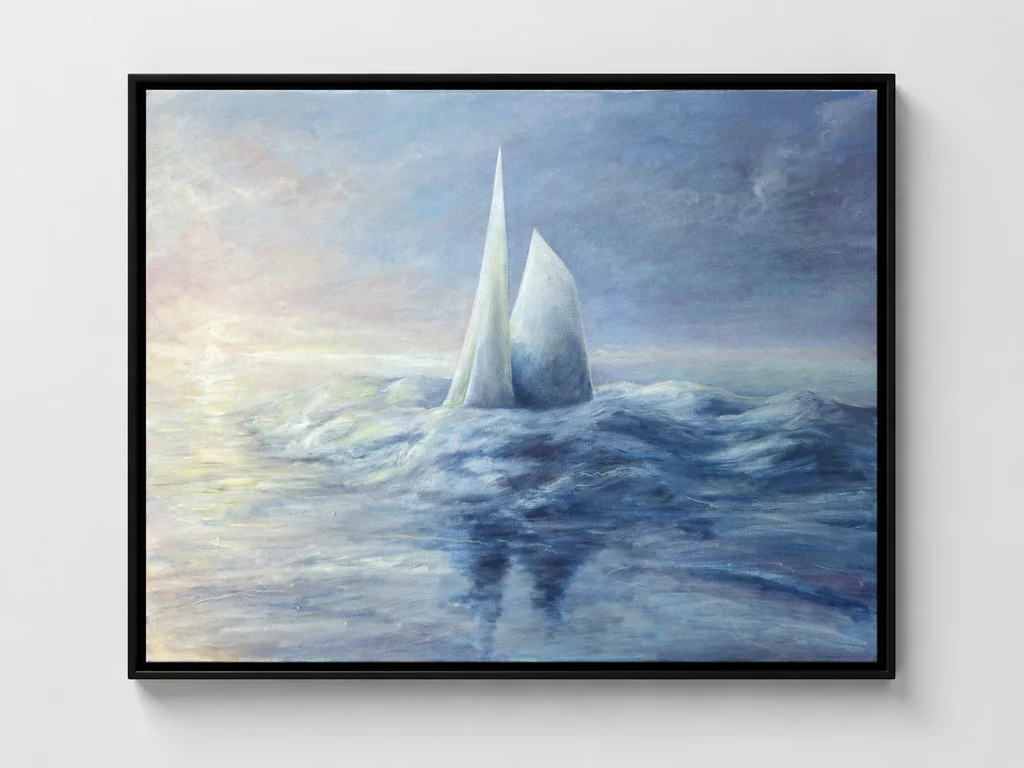
Within Bitcoin, 210000 is not arbitrary. Block 210000 marked the first halving, when the reward for mining a block changed from 50 bitcoin to 25. It was written into the protocol from the beginning, yet as the block approached it became something much larger socially. People watched for it, argued about what it would do to mining and price, celebrated it, and attached historical weight to a change that, at the level of the network, was remarkably simple. A threshold was reached, the reward changed, and the network continued.
When I began working with 210000, I assumed some of that weight would carry into the painting. There was enough material. Scarcity, economics, software, speculation, mining, and an entire community watching the same numerical threshold approach.
I began by thinking I was making a work from the first Bitcoin halving. During the DPM process, however, the landscape became more compelling to me than the event I had started with. The two forms and their relationship to the water survived through repeated changes, while much of what connected the image directly to Bitcoin fell away. When I moved into paint, I was no longer trying to represent the halving. I was trying to resolve the landscape that had come out of it.
What remained were two forms, water, distance, light, and a horizon.
I had been working for some time with the question of how technological systems enter a practice. Bitcoin was already part of that investigation. Artificial intelligence was entering it from another direction. I was documenting those decisions through the Direction Provenance Model, but the larger problem was no longer authorship. These technologies were changing the conditions under which I made work, which is a different thing from making work about them.
I have little interest in putting a Bitcoin logo into a painting to establish that Bitcoin is present. The same is true of AI. I do not need to paint a neural network for machine intelligence to have affected the picture. The influence happens much earlier. A blockchain introduces time, sequence, numerical relation, and a record of events. AI participates in visual development, testing, and transformation. I still decide what matters, what fails, what stays, and what becomes physical. By the time the work reaches canvas, most of the technology that shaped the process is no longer visible.
The painting does not look like Bitcoin, and I think that matters. Encountered without the title, there is no reason anyone should connect it to a network. They see two pale forms rising out of open water. The forms read closest to sails, but there is no hull beneath them and no vessel implied, so they never quite settle into being sails. The surrounding space is open enough that a viewer has to negotiate it rather than decode it.
For someone who knows what 210000 refers to, another layer opens. The title carries back the halving, the monetary schedule, the mining economics, and the history attached to that first transition. The viewer brings that into the landscape. The painting does not tell them what to do with it.
The event that generated the work and the experience of the finished work are not the same thing. One viewer may enter through the network. Another may enter through the water. Neither is required to arrive where the other does.
This is why I have become more interested in landscape as a structure than as a genre. It absorbs things that do not belong naturally to painting. A block height, a sequence of data, a network event, or an AI-assisted decision can all enter the process, and landscape converts them into its own terms: distance, scale, division, weight, atmosphere. Landscape does this regardless of the source material. That is precisely why I use it.
I want to be careful about a resemblance I noticed only afterward. The halving was austere at the level of the protocol and the painting arrived at something similarly reduced. That rhyme is real, but I do not think the event caused it. Landscape would have reduced any block I gave it. What 210000 made unusually clear was how much can be discarded on the way to an image, and how little of the source has to remain for the work to still carry the conditions of its making.
I do not think 210000 is finally a painting about Bitcoin culture. Bitcoin is essential to how it came into existence. It is not the limit of what the painting is about.
The larger subject is how networks have entered contemporary experience, and more specifically how they have entered my studio. Blockchain and AI are not sitting outside painting waiting to be illustrated. They operate inside the process, shaping how an image begins and how decisions are made, without needing to announce themselves in the result.
Something that began as a highly specific technological event passed through a network, through data, through digital processes, through my own decisions, and finally through paint.
What came out was not an image of technology. It was a landscape.
KB
Kenneth Burris is a New York-based oil painter, and studio director. His fine art practice centers on Data Becoming Form Landscapes, developed through the Direction Provenance Model, a methodology examining human authorship within AI-assisted creative work. He writes the Post-Globalist Essays.